Maickel (overleg | bijdragen)
k Text replacement - "{{Project GRG Project config}}" to ""
Maickel (overleg | bijdragen)
k Text replacement - "|category=" to "|category group="
 
(28 tussenliggende versies door dezelfde gebruiker niet weergegeven)
Regel 1: Regel 1:


{{Heading
| background color = #e4ecf3
|heading=Nudging for sustainable meaning
|start date=2021-02-01
|image=Nudging for sustainable meaning.png
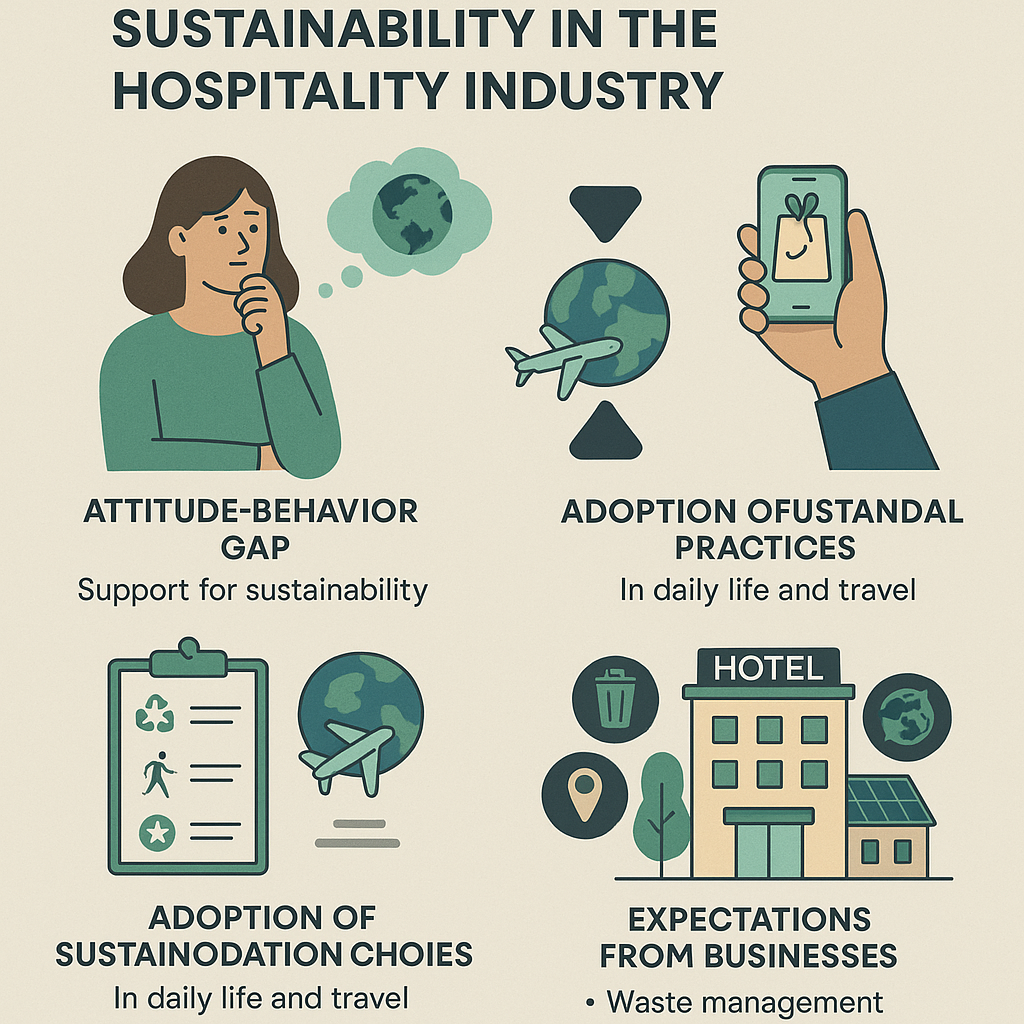
|summary=The survey of 19 respondents revealed that while most individuals feel responsible for practicing sustainability and actively engage in sustainable behaviors, their actual travel choices often prioritize price, location, and reviews over sustainability. There is a clear attitude-behavior gap, as many consumers express a desire for sustainable options but are reluctant to pay more or change their habits when traveling. Despite this, there is an expectation for businesses to adopt transparent and proactive sustainability practices, especially in waste management, local sourcing, and reducing environmental impact.
}}


{{Project
{{Project detail
|Name=Nudging for sustainable meaning
|description=This project investigates consumer attitudes and behaviors toward sustainability in the hospitality industry, focusing on the attitude-behavior gap—the difference between people's support for sustainability and their actual practices. Through a survey, we explored how consumers adopt sustainable practices in daily life and travel, and how these affect their choices in accommodations. The goal was to provide insights that could help businesses integrate sustainable practices without compromising customer experience.
|Part of=PR 00711
|outcomes=The project revealed that while most respondents feel a sense of responsibility for sustainability, their actual behavior often doesn't align with these attitudes, particularly when factors like price and convenience are involved. This highlights the presence of an attitude-behavior gap, where consumers express support for sustainability but prioritize cost, location, and reviews when selecting accommodations. Despite this, respondents expect businesses to be transparent and proactive in adopting sustainable practices, particularly in areas like waste management, local sourcing, and reducing environmental impact. The findings suggest that hospitality businesses should integrate sustainable options that don’t negatively affect customer experience or incur extra costs, while also educating consumers in subtle, appealing ways. Further research is needed to better understand the gap between sustainability attitudes and behaviors and to find solutions that can help businesses effectively implement sustainability in a way that resonates with customers.
|Start date=2021-02-01
|Imagename=Nudging for sustainable meaning.png
|Summary=The survey of 19 respondents revealed that while most individuals feel responsible for practicing sustainability and actively engage in sustainable behaviors, their actual travel choices often prioritize price, location, and reviews over sustainability. There is a clear attitude-behavior gap, as many consumers express a desire for sustainable options but are reluctant to pay more or change their habits when traveling. Despite this, there is an expectation for businesses to adopt transparent and proactive sustainability practices, especially in waste management, local sourcing, and reducing environmental impact.
|Supercontext=PR 00711
|Topcontext=PR 00709
|Show navigation tree=Nee
|Show new page button=Nee
|Show summary=Nee
|Show sub projects=Nee
|Show participants=Nee
|Show sources=Nee
|Is homepage=Nee
|Show edit button=Nee
|Show VE button=Ja
|Show category label=Nee
|Show title=Nee
}}
}}
{{Project GRG Project additional
{{Client
|Project description=This project investigates consumer attitudes and behaviors toward sustainability in the hospitality industry, focusing on the attitude-behavior gap—the difference between people's support for sustainability and their actual practices. Through a survey, we explored how consumers adopt sustainable practices in daily life and travel, and how these affect their choices in accommodations. The goal was to provide insights that could help businesses integrate sustainable practices without compromising customer experience.
|stakeholder=HZ Studio The Garage
|Outcomes=The project revealed that while most respondents feel a sense of responsibility for sustainability, their actual behavior often doesn't align with these attitudes, particularly when factors like price and convenience are involved. This highlights the presence of an attitude-behavior gap, where consumers express support for sustainability but prioritize cost, location, and reviews when selecting accommodations. Despite this, respondents expect businesses to be transparent and proactive in adopting sustainable practices, particularly in areas like waste management, local sourcing, and reducing environmental impact. The findings suggest that hospitality businesses should integrate sustainable options that don’t negatively affect customer experience or incur extra costs, while also educating consumers in subtle, appealing ways. Further research is needed to better understand the gap between sustainability attitudes and behaviors and to find solutions that can help businesses effectively implement sustainability in a way that resonates with customers.
}}
}}
{{GRG Project Client
{{Concept
|Stakeholder=STKH 00330
|category group=The Garage
|category page=Design Thinking & Doing
|category type=Project
}}
}}

Huidige versie van 9 feb 2026 16:56


About this project

Start date:
Project description:This project investigates consumer attitudes and behaviors toward sustainability in the hospitality industry, focusing on the attitude-behavior gap—the difference between people's support for sustainability and their actual practices. Through a survey, we explored how consumers adopt sustainable practices in daily life and travel, and how these affect their choices in accommodations. The goal was to provide insights that could help businesses integrate sustainable practices without compromising customer experience.
Outcomes:The project revealed that while most respondents feel a sense of responsibility for sustainability, their actual behavior often doesn't align with these attitudes, particularly when factors like price and convenience are involved. This highlights the presence of an attitude-behavior gap, where consumers express support for sustainability but prioritize cost, location, and reviews when selecting accommodations. Despite this, respondents expect businesses to be transparent and proactive in adopting sustainable practices, particularly in areas like waste management, local sourcing, and reducing environmental impact. The findings suggest that hospitality businesses should integrate sustainable options that don’t negatively affect customer experience or incur extra costs, while also educating consumers in subtle, appealing ways. Further research is needed to better understand the gap between sustainability attitudes and behaviors and to find solutions that can help businesses effectively implement sustainability in a way that resonates with customers.
Commissioned for:

(HZ Studio The Garage)


Nudging for sustainable meaning