
Geen bewerkingssamenvatting |
Geen bewerkingssamenvatting |
||
| Regel 5: | Regel 5: | ||
{{Create item | {{Create item | ||
|search=true | |search=true | ||
|filter=true | |||
|formatter=Media | |formatter=Media | ||
|categories=Seaweed Learning Community | |categories=Seaweed Learning Community | ||
Versie van 4 mrt 2026 12:19
Publications
Sea Futures
SEA FUTURES investigates the potential of seaweed as a regenerative and nutritional resource, integrating biological science, sustainability research, and artistic engagement. While seaweed provides ecological benefits and health-promoting compounds, its adoption in Western diets remains limited. This seed project aims to build new interdisciplinary connections and generate foundational knowledge to support broader food system transitions.
project
SeaSolv
An innovative and environmental-friendly technique using deep eutectic solvents (DESs) will be developed for a multiproduct biorefinery of seaweeds. The project will focus on the development and optimization of the process by knowing and controlling the interaction DES-seaweed and DES-product. Therefore, the combination of pre-treatments-extraction/fractionation- final product properties for the selected macroalgal biomass will be investigated. The techno-functional properties of the extracted products for food applications will be determined and a techno-economic evaluation of the optimal process at manufacturing scale will be provided. SeaSolv
project
SeaSeeds
Seaweeds are a promising though barely exploited source of biomass and proteins. Small scale cultivation trials show that large and variable detachment of seaweeds results in inefficient and unpredictable cultivation with high economic risks and an unknown impact on marine ecology. Consequently, the sector fails to attract investments, which complicates the upscaling required for profitability. We will improve attachment of sugar kelp, study the consequences of large scale seaweed culture on the marine ecology and create business models for Dutch seaweed. Our efforts will yield economic opportunities in, and societal awareness for the transition towards a sustainable blue economy.
SeaSeeds
project
Prospective seaweed systems for North-West European waters
Seaweed is a promising sustainable resource for food, feed, cosmetics, and biomaterials. While mostly cultivated in Asia, suitable systems for North-West Europe remain uncertain. This study identifies potential seaweed farming systems for different contexts, highlighting a preference for multi-species cultivation and automation. Key challenges include profitability, infrastructure, permits, and market uncertainty. The results support policy development and guide future research and technology.
publication
Marine fungal enzymes as potential degraders of the diverse seaweed cell-walls
Marine fungi play a critical yet understudied role in marine ecosystems, contributing to microbial diversity and ecological balance through their interactions with seaweed and other organisms. These interactions are essential for nutrient cycling and maintaining ecosystem health. While the carbohydrate-active enzymes (CAZymes) of terrestrial fungi are well-documented for plant biomass degradation, the enzymatic capabilities of marine fungi, specifically for degrading seaweed biomass, remain less explored. The distinct sugar composition of seaweed has likely shaped the CAZome of marine fungi, specifically in activities targeting seaweed cell wall polysaccharides. This review focuses on the potential of marine fungal CAZymes as biocatalysts for the degradation of seaweed cell wall polysaccharides. We provide a detailed examination of the unique sugar composition of seaweed cell walls, such as alginates, fucoidans, and carrageenans, and analyze the putative CAZy abilities of marine fungi to target these structures. A better understanding of marine fungal enzymatic processes could unlock sustainable strategies for extracting valuable compounds, such as proteins and nutraceuticals, from seaweed biomass, while enabling the comprehensive valorization of all biomass fractions within a biorefinery framework. By summarizing current knowledge and identifying research gaps, this review highlights the untapped potential of marine fungi as key agents in the development of efficient, integrated seaweed biorefineries.
publication
Global interfertility and heterosis in sugar kelp populations, a next step in sugar kelp breeding
The potential of seaweed aquaculture is restricted by high labor, production and processing costs, leading to low economic viability. Selective breeding can improve yields and cultivation efficiency, thereby decreasing production costs. Until now, genetic resources as input for Saccharina latissima breeding trials have been sourced strictly locally, due to concerns regarding outplanting genetically exogenous material in local waters. Here we study, for the first time, worldwide interregional fertility of the seaweed S. latissima, in order to assess the potential of including global S. latissima genetic resources for selective breeding with regard to heterosis. We quantified the yield (as an indicative aquacultural performance) and morphological traits of intra- and interregional S. latissima hybrids originating from a broad range of locations in a common garden experiment. Our results show that the practical application of worldwide S. latissima genetic resources in breeding programs is feasible based on global interfertility. We found a wide morphological diversity of hybrids and observed significant heterosis in interregional hybrids. The degree of heterosis could not be linked to geographic distance. These findings reveal that worldwide genetic resources can considerably contribute to S. latissima breeding programs and could offer a major next step in improving yields and quality traits.
publication
From Spores to Society: insights into the early lifecycle and breeding of seaweed
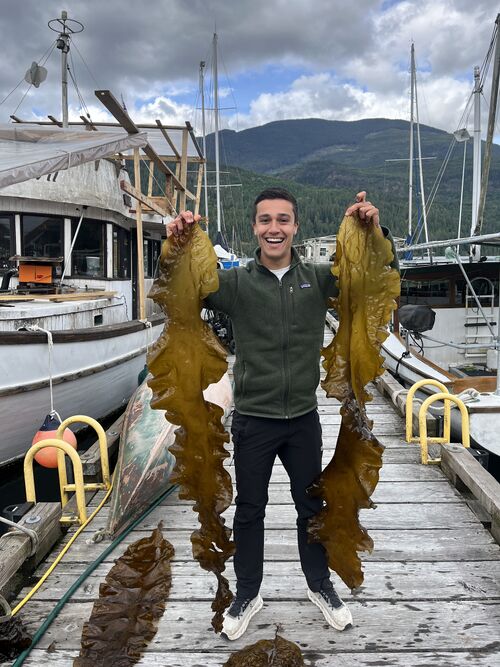
Seaweed is often hailed as one of the most promising sustainable resources of the future. It grows without agricultural land, needs no freshwater and can contribute to food, materials, and even bioplastics. Yet large-scale applications, especially in Europe, remain limited. Behind the scenes Job Cohen is working on a fundamental question: how can we cultivate seaweed better, faster and more efficiently?
publication
From Sea to Society (FS2S)
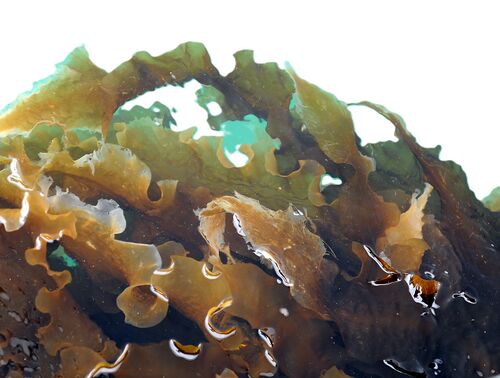
There is urgent need for an alternative, sustainable, efficient protein production chain. We will initiate a marine, efficient, sustainable low trophic aquaculture (LTA) chain, based on biomass from combined seaweed-mussel cultivation. Social innovation and creation of value along the protein production chain form the key goals of the project. They are supported by breakthroughs in the natural sciences, such as selective breeding of sterile seaweeds, innovative biorefinery of seaweed biomass and insight in the carrying capacity of the natural marine ecosystem. The knowledge and skills gained will be integrated in the FS2S learning community, that will ensure the LTA continuity. FS2S
project
FloatingFuture
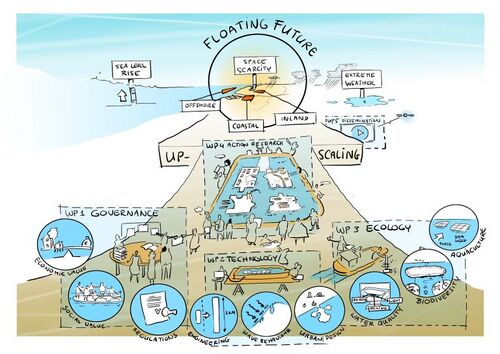
The Floating Future project is investigating the possibilities of large-scale floating developments as a possible addition to the present-day toolbox of coastal engineering. Floating settlements provide space and at the same time, the water can be used for other purposes. A floating foundation adapts to the changing water level, making it resilient to sea level rise, and can be relocated if needed. Floating Future
project
CircAqua
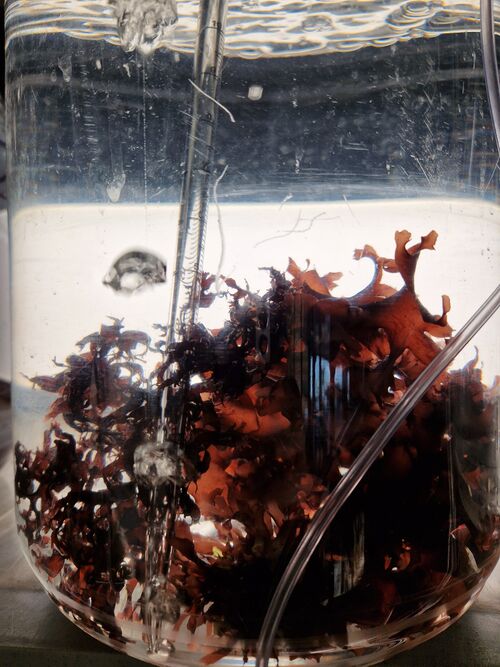
CircAqua will contribute knowledge for a new Blue Food Vision and Strategy for upscaling Low trophic offshore aquaculture in the North. The knowledge created will help revise the North Sea 2050 Spatial Agenda and provide a vision for biodiversity-inclusive spatial planning to 2120. The results of our research will also contribute to an improved understanding of carrying capacity and innovation governance for offshore food production. CircAqua
project
Blade density variations between cultivated sugar kelp strains are dependent on the genetic origin
Optimizing and standardizing seeding practices is essential to ensure high and reliable yields of cultivated Saccharina latissima (Laminariales, sugar kelp) and realize the development of large-scale cultivation. In parallel, selective breeding programs, for which worldwide genetic resources are used, can unlock possibilities for high-yielding strain development. The wide diversity of genetic material that is used in breeding programs, however, adds an extra layer of complexity when aligning and optimizing seeding practices for these different strains; large variations in blade density are observed when different strains are tested. This may be the result of variations in gametogenesis and juvenile sporophyte development that skew optimal seeding practices. In this study we evaluated the effectiveness of different sporophyte seeding times and seeding densities for increasing blade densities and balancing the observed variations in blade density when cultivating different S. latissima strains. The seeding time appeared to be a key factor in determining blade densities, whereas the seeding density only had a minor impact. Nonetheless, we did not find evidence that adapting seeding practices can compensate for the varying blade densities observed between strains. This leads us to a more general conclusion that blade densities on cultivated seaweed lines are genetically predisposed and/or influenced by (a)biotic factors that impair the development of certain strains. This would imply that blade density can serve as a selectable trait in breeding programs.
publication
A Comparison of the Biotechnological Potential of Marine and Terrestrial Species of Two Orders of Sordariomycete Fungi
Abstract Marine fungi have been receiving increasing interest, especially with respect to their potential for biotechnological applications. Carbon sources in marine environments, such as seaweeds, have cell walls that are structurally different from the cell walls of terrestrial plants, which implies that marine fungi likely possess a specific set of extracellular enzymes to enable them to use these marine substrates as carbon and energy source. In addition, marine fungi have been implicated as good sources of secondary metabolites with bioactive functions, as e.g., drugs and antibiotics. To evaluate if marine fungi have genomic signatures that distinguish them from terrestrial fungi with respect to biotechnological potential, we genome-sequenced three marine fungal species (Varicosporina prolifera, Corollospora maritima, Emericellopsis maritima), two terrestrial species (Clonostachys rosea, Stanjemonium grisellum), and one that is found in both terrestrial and marine environments (Microascus triganosporus) and compared them to taxonomically-related terrestrial (Microascus stellatus, Valetoniellopsis laxa) and marine species (Emericellopsis atlantica) for which genomes were already available. These fungi originate from two orders (Microascales, Hypocreales) of the Sordariomycetes. We then compared their carbohydrate-active enzymes and secondary metabolism content and their ability to use terrestrial and marine biomass as carbon sources. The analysis revealed that despite the presence of some genes specific to marine fungi, no general genomic or growth phenotypes can be identified to distinguish marine fungi from terrestrial fungi, suggesting that all have maintained the ability to use both marine and terrestrial carbon sources.
publication