k Maickel moved page PR 00824 to Water Technology - Hydroponic system without leaving a redirect |
k Text replacement - "|category=" to "|category group=" |
||
| (17 tussenliggende versies door dezelfde gebruiker niet weergegeven) | |||
| Regel 1: | Regel 1: | ||
{{Concept | |||
|parent=Applied Research (The Garage) | |||
{{ | |category page = Applied Research | ||
|category type=Project | |||
|category group=The Garage | |||
|hide title=true | |||
}} | |||
{{Heading | |||
|heading=2425 s1 - Water Technology - Hydroponic system | |heading=2425 s1 - Water Technology - Hydroponic system | ||
|start date=2024-02-05 | |start date=2024-02-05 | ||
|image=Water Technology- The garage.png | |image=Water Technology- The garage.png | ||
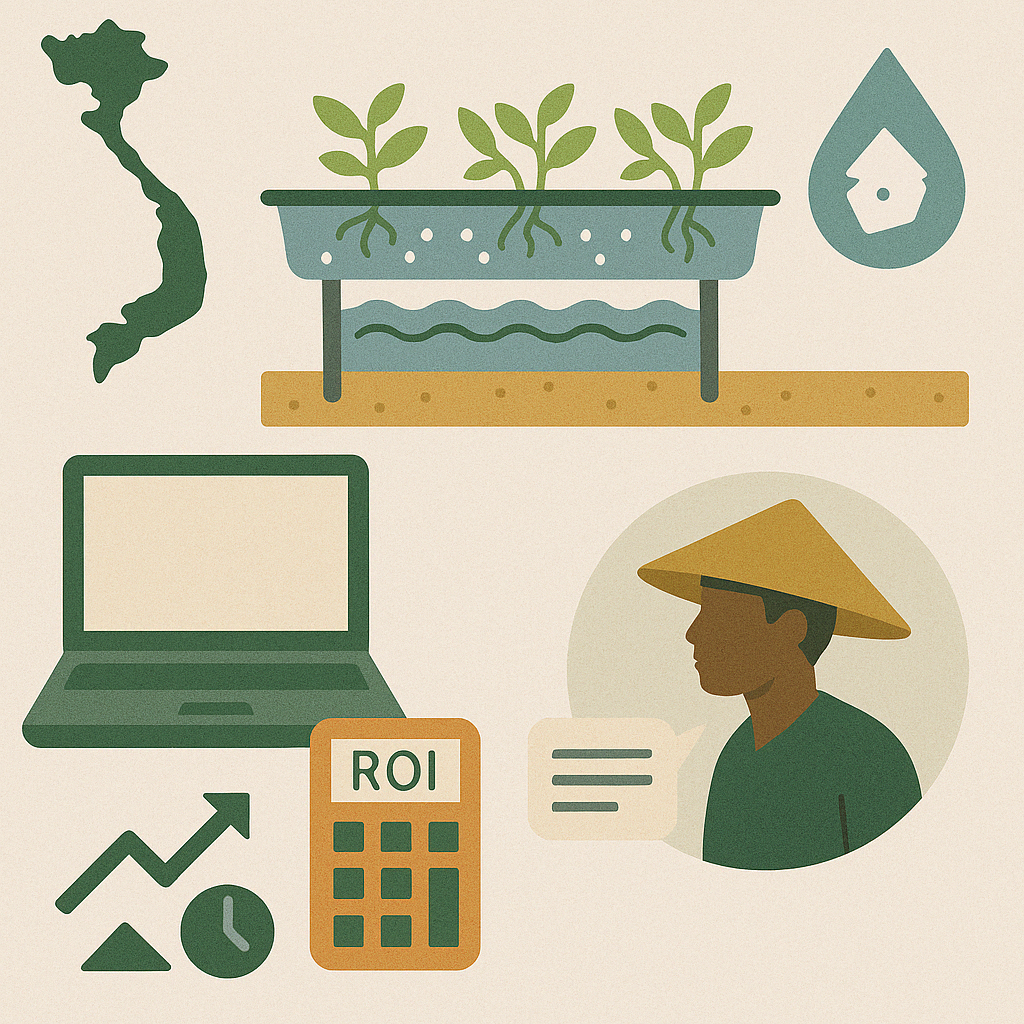
|summary=This research focuses on evaluating the financial viability of an open-field hydroponic system developed by the Mekong Saltlab to address the challenges faced by farmers in the salinity affected Mekong Delta, in Vietnam. A custom Excel tool was designed to calculate critical financial metrics such as Return on Investment (ROI) and payback period using real-world data. To complement this quantitative analysis, qualitative insights were collected through an interview with a farmer implementing the system. | |summary=This research focuses on evaluating the financial viability of an open-field hydroponic system developed by the Mekong Saltlab to address the challenges faced by farmers in the salinity affected Mekong Delta, in Vietnam. A custom Excel tool was designed to calculate critical financial metrics such as Return on Investment (ROI) and payback period using real-world data. To complement this quantitative analysis, qualitative insights were collected through an interview with a farmer implementing the system. | ||
}} | }} | ||
{{Project detail | {{Project detail | ||
|description=This research focuses on evaluating the financial viability of an open-field hydroponic system developed by the Mekong Saltlab to address the challenges faced by farmers in the salinity-affected Mekong Delta, in Vietnam. A custom Excel tool was designed to calculate critical financial metrics such as Return on Investment (ROI) and payback period using real-world data. To complement this quantitative analysis, qualitative insights were collected through an interview with a farmer implementing the system. | |description=This research focuses on evaluating the financial viability of an open-field hydroponic system developed by the Mekong Saltlab to address the challenges faced by farmers in the salinity-affected Mekong Delta, in Vietnam. A custom Excel tool was designed to calculate critical financial metrics such as Return on Investment (ROI) and payback period using real-world data. To complement this quantitative analysis, qualitative insights were collected through an interview with a farmer implementing the system. | ||
|outcomes=The findings indicate that the system offers significant advantages, such as water efficiency, reduced pesticide use, and year-round cultivation, even under adverse environmental conditions. Financially, the system demonstrates an ROI of 76.64 % and a payback period of approximately 1.3 years, even when applied to a low-value crop like water spinach. However, high initial investment costs and the need for technical expertise remain significant barriers to broader adoption. This research concludes that open-field hydroponics represents a promising solution for climate-adaptive farming in the Mekong Delta, offering both economic and environmental sustainability. The results serve as a foundation for future developments, including the potential expansion of the system to high-value crops and the creation of accessible tools for farmers. | |outcomes=The findings indicate that the system offers significant advantages, such as water efficiency, reduced pesticide use, and year-round cultivation, even under adverse environmental conditions. Financially, the system demonstrates an ROI of 76.64 % and a payback period of approximately 1.3 years, even when applied to a low-value crop like water spinach. However, high initial investment costs and the need for technical expertise remain significant barriers to broader adoption. This research concludes that open-field hydroponics represents a promising solution for climate-adaptive farming in the Mekong Delta, offering both economic and environmental sustainability. The results serve as a foundation for future developments, including the potential expansion of the system to high-value crops and the creation of accessible tools for farmers. | ||
| | |file=Water Technology..pdf | ||
}} | }} | ||
{{Client | {{Client | ||
| | |stakeholder=Lectoraat Resilient Deltas | ||
| | |contributor=Jasper van den Heuvel | ||
}} | }} | ||