k Text replacement - "Gebruiker:" to "User:" |
k Text replacement - "|category=" to "|category group=" |
||
| (9 tussenliggende versies door dezelfde gebruiker niet weergegeven) | |||
| Regel 1: | Regel 1: | ||
{{Concept | {{Concept | ||
|parent = Applied Research (The Garage) | |parent=Applied Research (The Garage) | ||
|category page = Applied Research | |category page = Applied Research | ||
|category type = | |category type=Project | ||
|category = The Garage | |category group=The Garage | ||
|hide title=true | |||
}} | }} | ||
{{Heading | {{Heading | ||
| Regel 15: | Regel 16: | ||
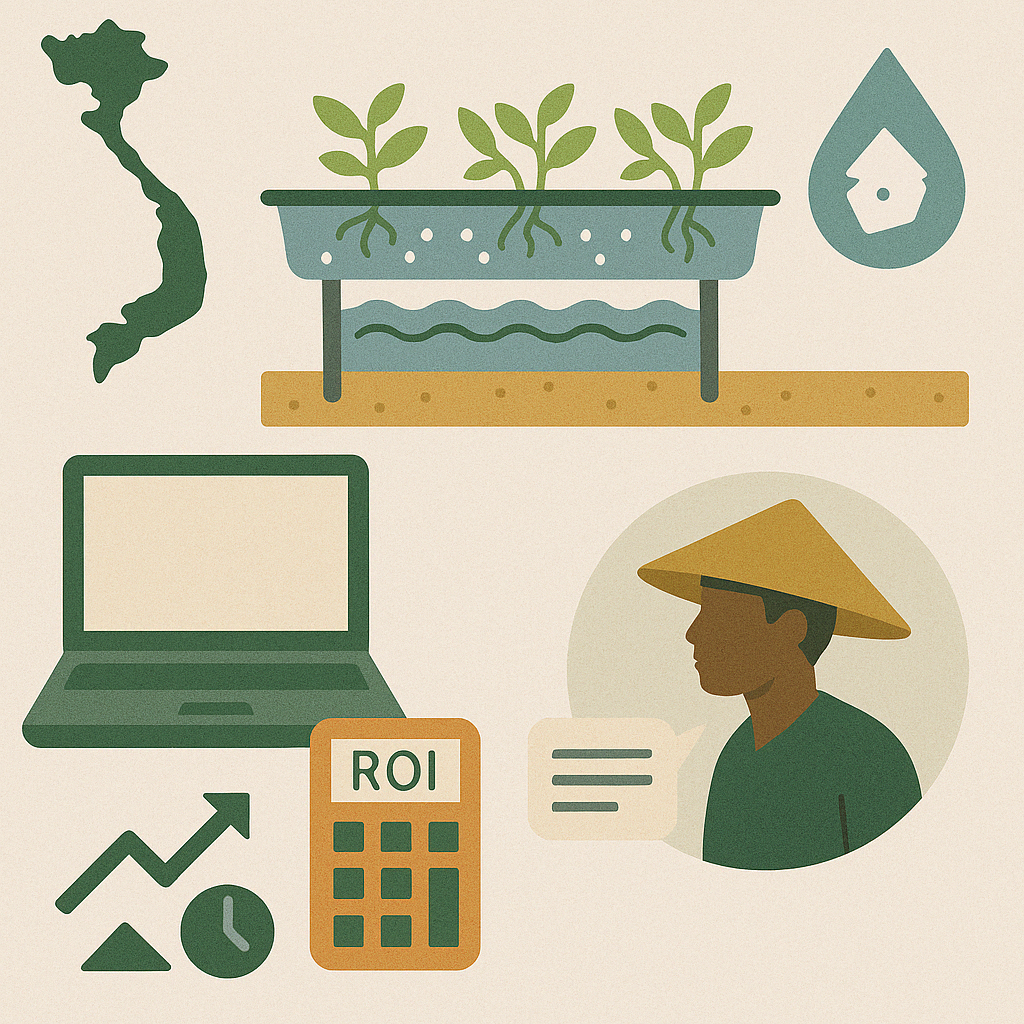
|outcomes=The findings indicate that the system offers significant advantages, such as water efficiency, reduced pesticide use, and year-round cultivation, even under adverse environmental conditions. Financially, the system demonstrates an ROI of 76.64 % and a payback period of approximately 1.3 years, even when applied to a low-value crop like water spinach. However, high initial investment costs and the need for technical expertise remain significant barriers to broader adoption. This research concludes that open-field hydroponics represents a promising solution for climate-adaptive farming in the Mekong Delta, offering both economic and environmental sustainability. The results serve as a foundation for future developments, including the potential expansion of the system to high-value crops and the creation of accessible tools for farmers. | |outcomes=The findings indicate that the system offers significant advantages, such as water efficiency, reduced pesticide use, and year-round cultivation, even under adverse environmental conditions. Financially, the system demonstrates an ROI of 76.64 % and a payback period of approximately 1.3 years, even when applied to a low-value crop like water spinach. However, high initial investment costs and the need for technical expertise remain significant barriers to broader adoption. This research concludes that open-field hydroponics represents a promising solution for climate-adaptive farming in the Mekong Delta, offering both economic and environmental sustainability. The results serve as a foundation for future developments, including the potential expansion of the system to high-value crops and the creation of accessible tools for farmers. | ||
|file=Water Technology..pdf | |file=Water Technology..pdf | ||
}} | }} | ||
{{Client | {{Client | ||
|stakeholder= | |stakeholder=Lectoraat Resilient Deltas | ||
|contributor= | |contributor=Jasper van den Heuvel | ||
}} | }} | ||