k Text replacement - "{{BB Hero d detail" to "{{Project detail" |
k Text replacement - "|category=" to "|category group=" |
||
| (18 tussenliggende versies door dezelfde gebruiker niet weergegeven) | |||
| Regel 1: | Regel 1: | ||
{{Concept | |||
|parent=Applied Research (The Garage) | |||
{{ | |category page = Applied Research | ||
|category type=Project | |||
|category group=The Garage | |||
|hide title=true | |||
}} | |||
{{Heading | |||
|heading=2425 s2 - Biobased Wet Cell | |heading=2425 s2 - Biobased Wet Cell | ||
| | |background color=#e4ecf3 | ||
|start date=2025-02-03 | |start date=2025-02-03 | ||
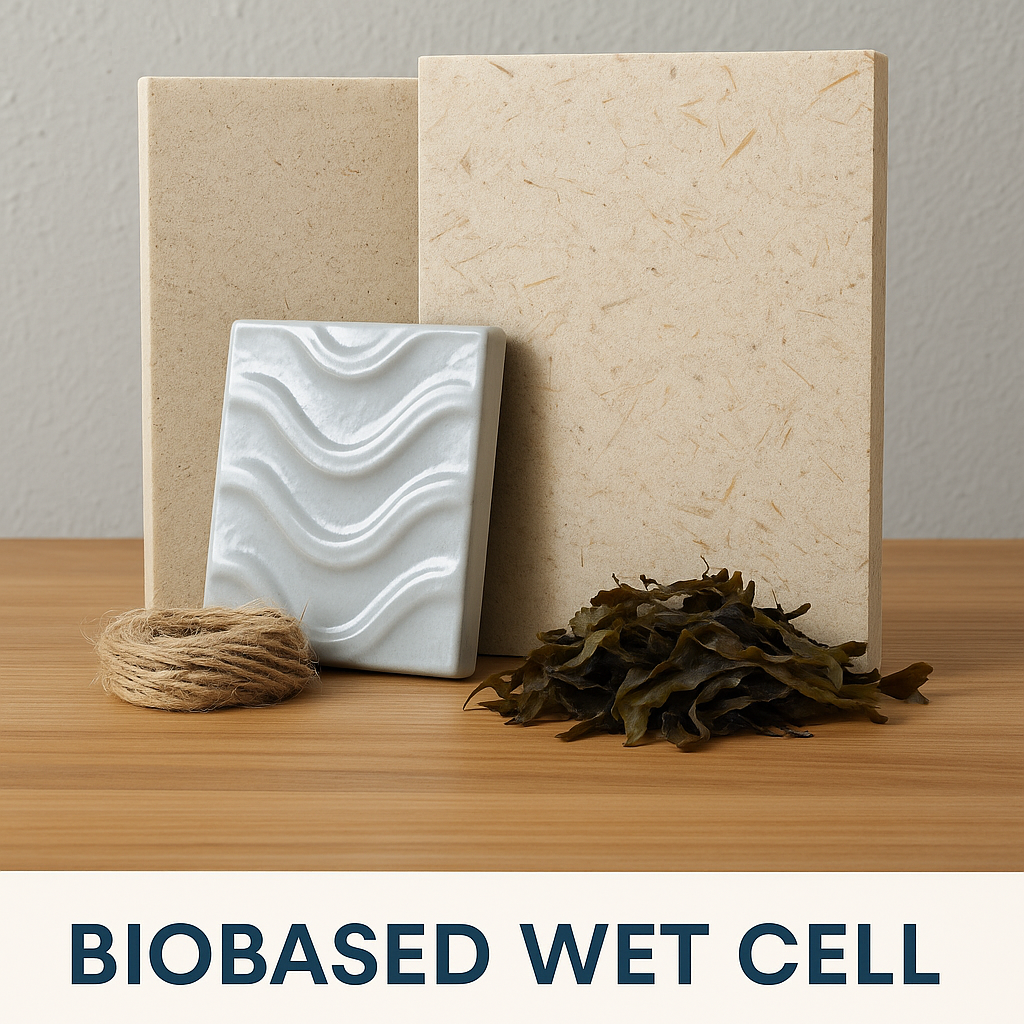
|image=Biobased Wet Cell.png | |image=Biobased Wet Cell.png | ||
|summary=In the Biobased Wet Cell project, researchers are looking to use biobased materials to make water-resistant wall panels for wet rooms, such as a bathroom. Marianna Coelho from the Biobased Building lectorate at HZ University of Applied Sciences is leading the project, which runs until the end of 2025. | |summary=In the Biobased Wet Cell project, researchers are looking to use biobased materials to make water-resistant wall panels for wet rooms, such as a bathroom. Marianna Coelho from the Biobased Building lectorate at HZ University of Applied Sciences is leading the project, which runs until the end of 2025. | ||
Biobased Wet Cell develops water-resistant wall panels for humid spaces (e.g., bathrooms) using geopolymeric or alkali-activated materials combined with seaweed-derived alginate and natural fibers. By replacing some sand and gravel with pretreated fibers, the panels become lighter, stronger (flexural strength roughly doubles), and better insulated (thermal and acoustic), while still meeting durability requirements. Alginate acts as a binder, and its extraction is integrated with fiber pretreatment in a single alkaline process—streamlining production and cutting CO₂ emissions. After optimizing geopolymer mixes, prototypes are tested with students and industry partners; a full wet-cell installation will follow, preparing this biobased solution for real-world use. This RAAK SME–funded project fosters collaboration between knowledge institutions and companies to advance sustainable building materials. | Biobased Wet Cell develops water-resistant wall panels for humid spaces (e.g., bathrooms) using geopolymeric or alkali-activated materials combined with seaweed-derived alginate and natural fibers. By replacing some sand and gravel with pretreated fibers, the panels become lighter, stronger (flexural strength roughly doubles), and better insulated (thermal and acoustic), while still meeting durability requirements. Alginate acts as a binder, and its extraction is integrated with fiber pretreatment in a single alkaline process—streamlining production and cutting CO₂ emissions. After optimizing geopolymer mixes, prototypes are tested with students and industry partners; a full wet-cell installation will follow, preparing this biobased solution for real-world use. This RAAK SME–funded project fosters collaboration between knowledge institutions and companies to advance sustainable building materials. | ||
}} | }} | ||
{{Project detail | {{Project detail | ||
| Regel 28: | Regel 20: | ||
have emerged as promising low-CO₂ alternatives, their widespread implementation is hindered by key durability and processing limitations—particularly in high-humidity or wet environments. This study seeks to move beyond empirical tweaking and instead focus on uncovering fundamental mechanisms that affect geopolymer stability and functionality in humid conditions. Ultimately, it aims to deliver a modified mixture and curing method capable of producing a geopolymer tile with low porosity, minimal efflorescence, consistent structural performance, and resilience in wet environments. the central research question is: How can the composition and curing conditions of a slag-based geopolymer be optimized to significantly improve water resistance and alkali | have emerged as promising low-CO₂ alternatives, their widespread implementation is hindered by key durability and processing limitations—particularly in high-humidity or wet environments. This study seeks to move beyond empirical tweaking and instead focus on uncovering fundamental mechanisms that affect geopolymer stability and functionality in humid conditions. Ultimately, it aims to deliver a modified mixture and curing method capable of producing a geopolymer tile with low porosity, minimal efflorescence, consistent structural performance, and resilience in wet environments. the central research question is: How can the composition and curing conditions of a slag-based geopolymer be optimized to significantly improve water resistance and alkali | ||
stability, without compromising mechanical performance, in high-humidity environments? | stability, without compromising mechanical performance, in high-humidity environments? | ||
| | |outcomes=The cured material does not exhibit a highly polymerized geopolymeric alumino-silicate structure. XRF analysis revealed a lower-than-expected alumina content (~8% vs. 12%), resulting in a high Si/Al ratio (~4.67), which limits stable geopolymer formation. This leads to weaker silica-rich gels prone to alkali leaching. | ||
Efflorescence (sodium carbonate) indicates strong alkali migration, while leachates consist mostly of amorphous silica. Unexpected mass gain after drying is likely due to CO₂ reacting with residual sodium silicates, forming stable gels, making gravimetric analysis unreliable. | Efflorescence (sodium carbonate) indicates strong alkali migration, while leachates consist mostly of amorphous silica. Unexpected mass gain after drying is likely due to CO₂ reacting with residual sodium silicates, forming stable gels, making gravimetric analysis unreliable. | ||
| Regel 39: | Regel 31: | ||
Use MAS NMR to better understand the structure and behavior of silicon and aluminum species in both the cured material and the silicate solutions. | Use MAS NMR to better understand the structure and behavior of silicon and aluminum species in both the cured material and the silicate solutions. | ||
| | |file=Research Poster (FILIP) (PDF) (1).pdf | ||
| | |link=https://www.mnext.nl/nieuws/biobased-wet-cell/ | ||
}} | }} | ||
{{Client | {{Client | ||
| | |stakeholder=Lectoraat Biobased Bouwen | ||
| | |contributor=Marianna Ansiliero de Oliveira Coelho | ||
}} | }} | ||